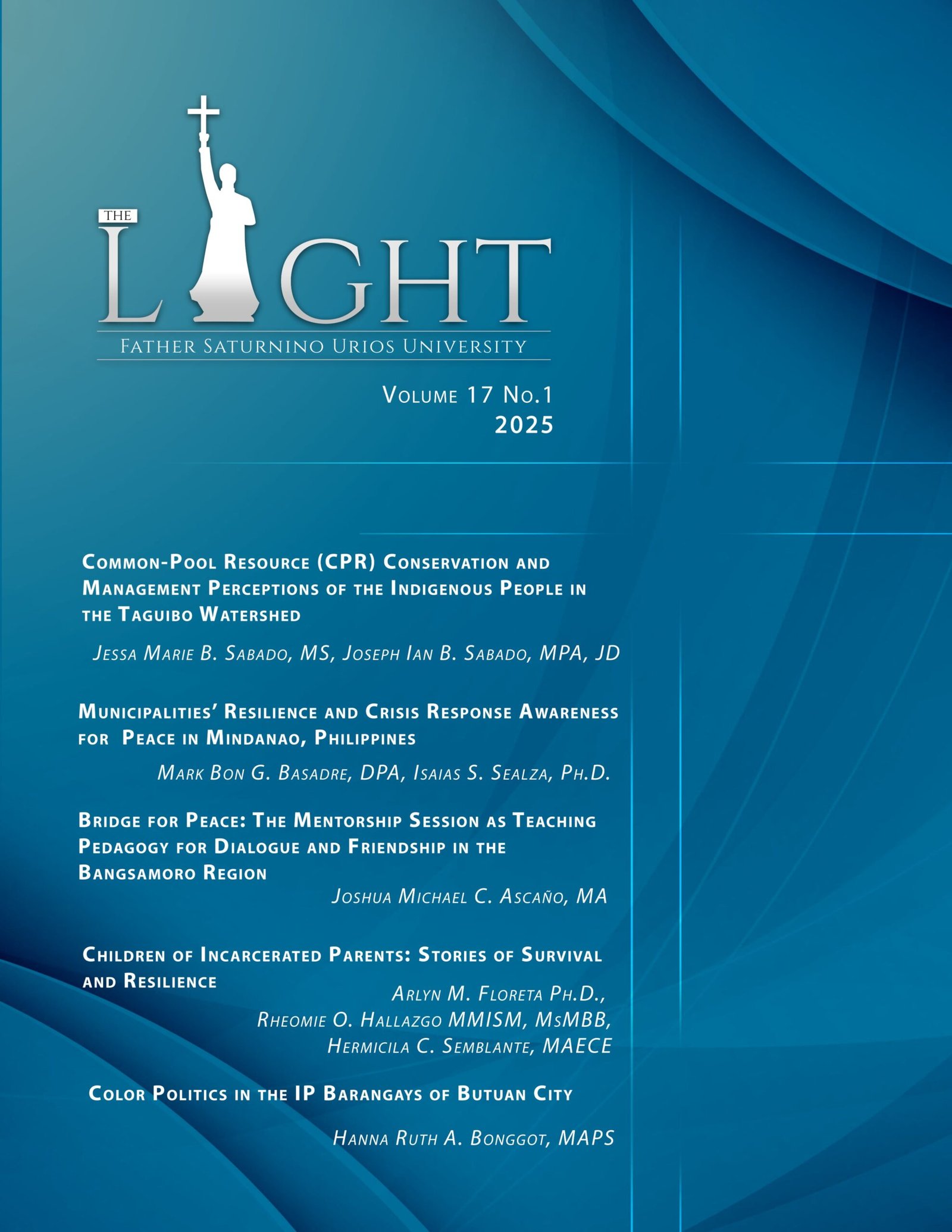
This edition of The Light Journal features compelling
research articles presented during the 8th Mindanao Peace
Studies Conference, which carried the theme “Resilience
and Harmonization for Peace and Development in
Mindanao” . The selected contributions in this volume
reflect the rich diversity of narratives and methodologies
that collectively promote the ethos of peacebuilding
grounded in resilience, community engagement, and
critical inquiry.
The opening article by Jessa Marie B. Sabado and Joseph
Ian B. Sabado explored the perceptions of Indigenous
Peoples on the conservation and management of the
Taguibo Watershed—a vital resource for Butuan City.
Through qualitative methods, the study underscored the
community’s belief in the effectiveness of indigenous-led
stewardship, emphasizing the importance of inclusive
participation and sustained efforts toward environmental
resilience.
In the second article, Mark Bon G. Basadre and Isaias S.
Sealza investigated the resilience of municipalities and their
capacity for crisis response, especially in the context of the
COVID-19 pandemic. Drawing on household-level data and
municipal competitiveness indicators, the study
highlighted how institutional resilience contributes to
public awareness and strengthens peacebuilding efforts at
the grassroots level.
Joshua Michael C. Ascaño, in his article, presented an
innovative pedagogy rooted in mentorship through the
Madaris Volunteer Program. His work documented how
online mentorship during the pandemic became a venue
for meaningful dialogue, friendship, and intercultural
understanding between educators—reinforcing the idea
that peace can be nurtured through shared learning
experiences and human connection.
The fourth article, authored by Arlyn M. Floreta, Rheomie O.
Hallazgo, and Hermicila C. Semblante, shed light on the
experiences of children with incarcerated parents. The
study provided a sensitive and timely account of how these
children navigate disrupted family dynamics and socio-
economic instability. Remarkably, the study also surfaced
their stories of survival and resilience, offering
recommendations for more responsive social support
systems.
Closing the issue is Hanna Ruth A. Bonggot’s article on color
politics in the Indigenous Peoples' barangays of Butuan
City. Focusing on political behavior during the 2022 national
elections, the study examined how symbolic elements such
as color shape political identity and electoral choices
among IP communities. The findings revealed the influence
of narratives around leadership, continuity, and unity in
shaping democratic participation at the margins.
Collectively, the articles in this issue provided nuanced
perspectives on peace and resilience in Mindanao whether
through environmental stewardship, governance and
service delivery, educational dialogue, socio-emotional
healing, or political participation. It is hoped that this edition
invites continued reflection and discourse, and affirms our
shared commitment to peace, justice, and inclusive
development in Mindanao and beyond.
Shirlene Medori T. Alegre, PhD
Editor in Chief